My early training in a London patisserie taught me that true dessert mastery begins with the relationship between mass and volume. This Stitch Cake is built upon a foundation of mathematical precision, using an equal-weight method that I have refined over years of technical practice. By balancing the weight of the eggs with the dry ingredients, we create a chocolate sponge with a structural integrity that remains incredibly light on the palate.

This recipe pairs a dense, cocoa-rich sponge with the sophisticated silkiness of a Swiss meringue buttercream. It is a dessert designed for the ambitious home baker who values the science of emulsification and the beauty of a stable, glossy finish. Every bite offers a specific textural progression, moving from the firm bite of the chilled sponge to the immediate melt of the meringue coating.
Structure Meets Texture
The beauty of this Stitch Cake lies in its uncompromising approach to the traditional sponge method. Unlike standard recipes that rely on volume measurements, this method requires you to weigh your eggs first, allowing the rest of the ingredients to follow the lead of the protein. This creates a crumb that is remarkably uniform, with tiny air pockets that provide a gentle resistance before dissolving. It is the definitive balance of strength and softness.
Technically, the Swiss meringue buttercream is the star of the show. While American buttercream can often feel grainy and overly sweet, this meringue-based frosting is a triumph of aeration and fat suspension. It provides a clean mouthfeel that does not coat the tongue in a heavy film, allowing the nuance of the high-quality cocoa and the optional coconut extract to shine through. The addition of fresh cherries adds a hit of acidity and a tactile snap that breaks through the creaminess.
Furthermore, the stability of this cake is unmatched. Because we use the equal-weight method, the sponge is robust enough to hold up under the weight of the buttercream and decorations without compressing. Whether you are preparing this for a celebratory gathering or a quiet technical challenge, the result is a professional-grade dessert that looks as structured as it feels luxurious. It is a proof of concept that precision in the kitchen leads to superior results.
Print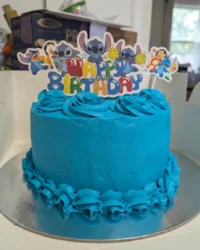
Stitch Cake
- Total Time: 1 hour 15 mins
- Yield: 12 servings
- Diet: Vegetarian
Description
A sophisticated chocolate sponge cake crafted with mathematical precision using the equal-weight method. Topped with a silky Swiss meringue buttercream and fresh cherries, this dessert offers a perfect balance of structural integrity and a melt-in-your-mouth texture.
Ingredients
- 400g Large Eggs (weighed in shells)
- 400g Caster Sugar
- 400g Unsalted Butter, softened
- 325g Self-Raising Flour
- 75g High-Quality Cocoa Powder
- 4 Large Egg Whites
- 260g Granulated Sugar
- 230g Unsalted Butter, cool and cubed
- Coconut Extract
- Pinch of Salt
- Fresh Cherries
Instructions
- Preheat oven to 180°C (160°C fan) and grease and line two 8-inch cake tins with parchment paper.
- Weigh your eggs in their shells and ensure the sugar and butter measurements match that weight exactly for the sponge.
- Cream together the butter and sugar in a large bowl until the mixture is light, pale, and fluffy.
- Beat in the eggs one at a time, then sift in the flour and cocoa powder and fold gently until just combined.
- Divide the batter between the tins and bake for 40–45 minutes until a skewer comes out clean.
- Prepare a bain-marie and whisk the egg whites and granulated sugar until the mixture reaches 71°C (160°F).
- Whisk the warm meringue in a stand mixer on medium-high until the bowl is cool and stiff, glossy peaks form.
- Switch to a paddle attachment and gradually add the cool, cubed butter until a smooth, thick buttercream forms; mix in salt and extract.
- Stack the cooled cakes with a layer of buttercream, frost the exterior, and garnish with piped swirls and fresh cherries.
Notes
To ensure the meringue reaches full volume, wipe your mixing bowl and whisk with a little lemon juice or vinegar beforehand to remove any trace of grease. If the buttercream feels too soft after mixing, refrigerate the entire bowl for 15 minutes before giving it a final whip to achieve the perfect piping consistency.
- Prep Time: 30 mins
- Cook Time: 45 mins
- Category: Dessert
- Method: Baking
- Cuisine: British
The Technical Foundation

To achieve the perfect melt-in-your-mouth experience, every ingredient in this Stitch Cake must be selected for its specific chemical contribution to the final structure. We do not just look at flavor; we look at protein content, fat percentages, and moisture levels.
- Large Eggs (approx. 400g): The eggs are the primary structural component of our sponge. They provide the water for steam leavening and the proteins that set the cake’s shape. Weighing them in their shells is the first step toward a perfectly balanced batter.
- Caster Sugar (400g): This fine-grained sugar dissolves more efficiently than granulated varieties, facilitating a more stable aeration during the creaming stage. It tenderizes the crumb by interfering with gluten development.
- Unsalted Butter (400g + 230g): We use unsalted butter to maintain total control over the seasoning. For the sponge, it must be softened to exactly room temperature to hold the air bubbles created during mixing. For the buttercream, cool and cubed butter is necessary to maintain the emulsion.
- Self-Raising Flour (325g): This flour contains a precise ratio of leavening agents that work in tandem with the physical aeration from creaming. The lower protein content compared to bread flour guarantees a tender bite.
- High-Quality Cocoa Powder (75g): We use a significant portion of cocoa to provide deep color and a robust flavor profile. Cocoa is a drying agent, so its ratio to the flour is strictly calculated to prevent a crumbly texture.
- Swiss Meringue Components: Four large egg whites and 260g of granulated sugar form the base. The sugar must be fully dissolved into the whites over a bain-marie to prevent graininess. This process denatures the proteins, allowing them to stretch and hold air with incredible stability.
- Coconut Extract and Salt: These are our flavor modulators. The salt acts as a bridge between the sweetness of the sugar and the bitterness of the cocoa, while the extract adds a subtle complexity that defines the Stitch Cake profile.
- Fresh Cherries: Selected for their firmness and stem integrity, these provide the final visual and textural contrast. The natural acidity of the fruit cuts through the rich fats of the buttercream.
The Method
Step 1: Precise Preparation
Preheat your oven to 180°C [350°F] or 160°C fan. This specific temperature is vital for the initial lift of the sponge. Grease and line two 8-inch (20cm) cake tins with professional-grade parchment paper. This creates a barrier that allows the cake to climb the walls of the tin evenly.
Step 2: The Equal-Weight Calculation
Weigh your eggs in their shells. If you have 400g of eggs, you must use 400g of sugar and 400g of butter. This 1:1:1 ratio is the golden rule of British sponge making. If your eggs weigh slightly more or less, adjust the sugar and butter to match that exact figure to maintain the structural equilibrium.
Step 3: The Creaming Phase
In a large bowl, cream together the sugar and butter. You are looking for a light, pale, and fluffy texture. This process is not just about mixing; it is about mechanical aeration. The sugar crystals cut into the butter, creating millions of tiny air pockets that will expand in the heat of the oven.
Step 4: Emulsifying the Batter
Add the eggs one at a time, beating thoroughly after each addition. If the mixture looks like it is curdling, add a tablespoon of your flour to stabilize the emulsion. Once fully incorporated, sieve in the flour and cocoa powder. Folding these in gently prevents over-working the gluten, which would lead to a tough, bready texture.
Step 5: The Bake and Listen Test
Divide the batter evenly between the tins and bake for 40–45 minutes. Avoid opening the oven door before the 35-minute mark to prevent a structural collapse. The sponges are ready when a skewer comes out clean and the surface bounces back. A professional trick is to listen to the cake; if it is silent or makes only a very faint bubbling sound, the internal moisture has reached the correct level.
Step 6: Preparing the Bain-Marie
While the cakes cool upside down on a wire rack to maintain height, start the Swiss meringue. Whisk the sugar and egg whites in a clean bowl over a saucepan of simmering water. The bowl must not touch the water, as direct heat will scramble the proteins. Whisk until the mixture reaches 71°C [160°F] or until the sugar granules are no longer felt between your fingers.
Step 7: Achieving Stiff Peaks
Transfer the warm mixture to a stand mixer with a whisk attachment. Beat on medium-high until the bowl feels cool to the touch and the meringue forms glossy, stiff peaks. This can take 10 minutes or more. The cooling is essential; if the meringue is warm when the butter is added, the frosting will melt into a soup.
Step 8: The Butter Integration
Switch to the paddle attachment. Add the cool, cubed butter one piece at a time. The mixture may appear to curdle or deflate midway through—this is normal. Continue beating, and the emulsion will suddenly come together into a smooth, buttery cloud. Add your salt and extract at the very end.
Step 9: Assembly and Decoration
Place the first cooled sponge on a cake board. Apply a generous, even layer of buttercream to create a stable middle tier. Top with the second sponge. Use a palette knife to smother the exterior in the remaining buttercream. For the top swirls, pipe in a compass pattern (12, 6, 3, and 9 o’clock) to guarantee even spacing before filling the gaps. Top each swirl with a fresh cherry.
Precision Secrets

To achieve the ultimate structural success with this Stitch Cake, temperature control is your most powerful tool. If your Swiss meringue buttercream breaks or looks curdled, it is almost always a temperature issue. If it is too cold and lumpy, wrap a warm towel around the bowl while mixing. If it is too runny, chill the bowl for 15 minutes and then beat it again. This buttercream is incredibly resilient if you understand how to manipulate the fat solids. For more chocolate-based technical insights, you might find our old-fashioned chocolate cake guide helpful for mastering the balance of cocoa and moisture. Always make sure your mixing bowl is completely grease-free before starting your meringue, as even a molecule of fat from a previous recipe will prevent the egg proteins from bonding and expanding into those necessary stiff peaks.
Technical Variations
While the chocolate and cherry combination is a classic, you can modify the structural profile of this Stitch Cake with a few precision tweaks. For a brighter, more acidic version, replace the cocoa with an equal weight of flour and incorporate lemon zest into the batter, similar to the techniques used in our lemon rainbow cake. If you wish to lean into the theme, you can find various creative Stitch cake ideas that utilize different piping techniques or fondant accents to create a more character-driven aesthetic. Another sophisticated variation involves replacing the coconut extract with a high-quality almond extract and using toasted slivered almonds between the layers to add a brittle, crunchy texture that contrasts with the soft crumb.
Presentation Precision

When serving a multi-layered masterpiece like this, the goal is to maintain the clean lines of the interior structure. Use a long, serrated knife dipped in hot water and wiped dry between every single cut. This prevents the buttercream from dragging through the dark cocoa sponge, keeping each slice looking sharp and professional. If you are serving this at a themed event, consider how the height of this cake complements other geometric bakes, such as a car cake, to create a visually diverse dessert table. Serve each slice at room temperature to allow the butter in both the sponge and the meringue to soften, providing that signature melt-on-the-tongue sensation that defines high-end pastry.
Master the Craft
Creating the perfect Stitch Cake is a victory of technique over haste. By respecting the weights and temperatures of your ingredients, you have produced a dessert that stands as a testament to the beauty of pastry science. The chocolate sponge provides the necessary architecture, while the Swiss meringue buttercream offers a sophisticated finish that is never cloying. For more technical challenges and to continue building your baking repertoire, explore our full recipe index. I would love to see your structural triumphs; please share your results with our community of ambitious bakers. Join the conversation on Facebook and Instagram to showcase your latest kitchen victories.