During my London apprenticeship, I learned that a cookie’s chew depends on moisture retention. This Chewy Cookie Cake uses precise sugar ratios to create a soft center and a firm, clean edge.

Achieving the perfect balance between a sturdy slice and a melting bite requires specific thermal control. This recipe provides a structural foundation that supports rich buttercream without becoming dry, creating a superior mouthfeel. By understanding the science of gluten and fat, we can produce a dessert that is far more sophisticated than a standard traybake.
Structure Meets Texture
The beauty of this Chewy Cookie Cake lies in its duality. Most amateur bakers struggle with cookie cakes that are either too hard and brittle or too soft and messy to slice. This methodical approach uses a higher ratio of brown sugar to white sugar, which introduces molasses for hygroscopic moisture retention. This means the cake stays soft for days. We also use a specific creaming time to build just enough air into the fat without turning it into a sponge cake, maintaining that dense, satisfying chew that defines a premium pastry experience.
Print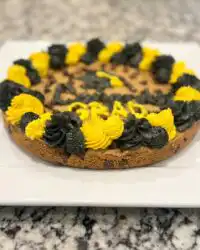
Chewy Cookie Cake
- Total Time: 1 hour
- Yield: 12 servings
- Diet: Vegetarian
Description
This decadent cookie cake features a perfect balance of crispy edges and a soft, chewy center achieved through precise sugar ratios and temperature control. It is finished with a delicate buttercream border, making it the ideal centerpiece for any special occasion.
Ingredients
- 1 cup unsalted butter, softened to 65°F
- 3/4 cup granulated sugar
- 3/4 cup light brown sugar, packed
- 2 large eggs, room temperature
- 1 teaspoon vanilla extract
- 2 1/4 cups all-purpose flour
- 1 teaspoon baking soda
- 1/2 teaspoon sea salt
- 1 1/2 cups semi-sweet chocolate chips
- 1/2 cup unsalted butter, softened (for frosting)
- 2 cups powdered sugar
- 1 tablespoon heavy cream
Instructions
- Preheat oven to 350°F and line a 9-inch round pan with parchment paper.
- Cream the 1 cup of butter and both sugars for 3 minutes, then beat in eggs and vanilla.
- Whisk flour, baking soda, and salt; gradually add to the wet ingredients until just combined, then fold in chocolate chips.
- Press dough into the pan and bake for 22 minutes until edges are set but the center looks slightly soft.
- Cool completely on a wire rack before frosting.
- Beat frosting ingredients until smooth and pipe around the border of the cooled cake.
Notes
For the best results, ensure your butter and eggs are at the specified temperatures to maintain proper emulsion. Using a digital kitchen scale for measuring flour is highly recommended to avoid a dry, cakey texture. Always let the cookie cake cool entirely before adding the frosting to prevent it from melting.
- Prep Time: 20 mins
- Cook Time: 22 mins
- Category: Dessert
- Method: Baking
- Cuisine: American
Ingredient Precision and Foundation

The chemical interaction of these components dictates the final structural integrity. To achieve the perfect Chewy Cookie Cake, every measurement must be exact.
- Unsalted Butter (82% fat content): It is vital that your butter is at 65°F (18°C). This temperature allows for the correct level of aeration during the creaming stage. If it is too warm, the cake will collapse; too cold, and the sugar won’t properly integrate.
- Granulated and Light Brown Sugar: The granulated sugar provides crispness via caramelization, while the light brown sugar adds the acidity needed to react with the baking soda and provide that characteristic chew.
- All-Purpose Flour: We look for a protein content around 10-11%. This provides enough gluten for structure but keeps the crumb tender. If you swap for whole-wheat pastry flour, you must add a splash of milk to compensate for the higher fiber absorption.
- Large Eggs: They must be room temperature to maintain the emulsion. Cold eggs will cause the butter to seize, resulting in a broken batter and a greasy texture.
- Semi-Sweet Chocolate Chips: The cocoa butter in quality chocolate adds to the overall fat profile, contributing to the melt-in-your-mouth sensation.
The Technical Process
Step 1: Pan Preparation and Oven Calibration
Preheat your oven to 350°F (175°C). Use an oven thermometer to confirm accuracy, as even a 10-degree variance affects the chew. Line a 9-inch round cake pan with parchment paper, allowing a 1-inch overhang. This structural precaution allows you to lift the Chewy Cookie Cake out without disturbing the delicate edges after baking.
Step 2: The Emulsification Stage
In a stand mixer fitted with the paddle attachment, beat the room-temperature butter and both sugars for exactly 3 minutes on medium speed. We are looking for the ‘creaming’ effect where the sugar crystals tear small air pockets into the fat. Add the eggs one at a time, followed by the vanilla, ensuring each is fully incorporated before adding the next to maintain a stable emulsion.
What is the secret to a chewy cookie?
The secret lies in the ratio of moisture to protein. Using a high proportion of brown sugar (which contains molasses) and avoiding over-baking allows the sugar to remain in a liquid-like state within the structure, creating that specific ‘chew’ rather than a crisp snap.
What is the difference between a cookie and cookie cake?
A cookie cake is baked in a single vessel, which limits the evaporation of moisture from the edges. This produces a much softer, denser center compared to individual cookies, which have more surface area exposed to dry oven air.
What is the secret to a soft cookie cake?
Under-baking is the primary technical cue. You must remove the cake when the center still appears slightly ‘wet’ or soft. The residual heat (carry-over cooking) will set the proteins without evaporating all the moisture.
What makes a cookie cakey vs chewy?
A cakey texture is caused by too much air (over-creaming) or too much leavening (baking powder). A chewy texture is achieved through minimal aeration, high moisture ingredients, and controlled gluten development.
Step 3: Folding and Gluten Control
Whisk the flour, baking soda, and sea salt in a separate bowl. Turn the mixer to the lowest setting and add the dry ingredients in two batches. Stop the moment no streaks of flour remain. Over-mixing at this stage develops too much gluten, which would turn our Chewy Cookie Cake into a tough, bread-like disk rather than a melting delight. Gently fold in the chocolate chips by hand.
Step 4: The Bake and Carry-Over Heat
Press the dough evenly into the prepared pan using a dampened offset spatula. Bake for 22 minutes. The edges should be set and golden, but the center must look slightly underdone. This is the secret to the texture; carry-over cooking will finish the center as it cools on a wire rack, preserving the moisture.
Step 5: Masterful Buttercream
Beat the softened butter for the frosting until it reaches a pale, ivory color. Sift the powdered sugar twice to prevent lumps. Slowly incorporate the sugar, vanilla, and heavy cream. Beat on high for 2 minutes to create a light, stable structure that is easy to pipe.
Step 6: Decorative Assembly
Once the cake is completely cold (around 70°F/21°C), pipe the buttercream around the border. If the cake is even slightly warm, the fat in the frosting will melt, ruining the visual precision. Use an offset spatula for a clean, professional finish.
Precision Secrets for the Perfect Bake

Temperature is your most important tool when making a Chewy Cookie Cake. If your kitchen is over 75°F, chill your dough in the pan for 15 minutes before baking to control the fat melt. This prevents the edges from becoming too thin and oily. For those looking to master other textural triumphs, I highly recommend checking out our ooey-gooey-butter-cake which focuses on a similar moisture-rich crumb. Also, for more inspiration on cookie design, you can look at this cookie cake resource to see various aesthetic finishes. Always use a digital scale for your flour; volume measurements with cups are notoriously inaccurate and can result in a dry, cakey texture rather than the intended chew.
Technical Tweaks and Advanced Options
You can modify the structural profile of this Chewy Cookie Cake by altering the chocolate types. Using a blend of 70% dark chocolate chunks and milk chocolate chips provides a complex flavor profile and varying melting points. If you prefer a more cocoa-forward base, you might study our brownie-cake for tips on integrating melted chocolate directly into the batter. For a festive twist, replace the chocolate chips with white chocolate and crushed macadamia nuts, but reduce the granulated sugar by 1 tablespoon to balance the extra sweetness of the white chocolate.
Presentation Precision

For the cleanest slices, use a long, thin-bladed knife dipped in hot water and wiped dry between every cut. This prevents the buttercream from dragging through the cookie base. This Chewy Cookie Cake is best served at room temperature to allow the butter to soften for the ideal mouthfeel. If you are hosting a larger event and need bite-sized options, consider our cake-mix-cookies as a secondary textural contrast. Pair each slice with a dollop of unsweetened whipped cream to balance the richness of the chocolate and buttercream.
Master the Craft
Mastering this Chewy Cookie Cake is a victory in pastry physics. By controlling the temperature of your fats and the development of your gluten, you have created a dessert that is structurally sound yet exquisitely tender. For more technical guides on creating the cookie-cake of your dreams, stay tuned to our upcoming masterclasses. I would love to see your results; please share your bakes and tag us on Instagram, Pinterest, or Facebook to show off your precision.