British afternoon tea depends on the exact structural friction between a tender cake and a crisp crumble, a balance that requires precise fat distribution to succeed.

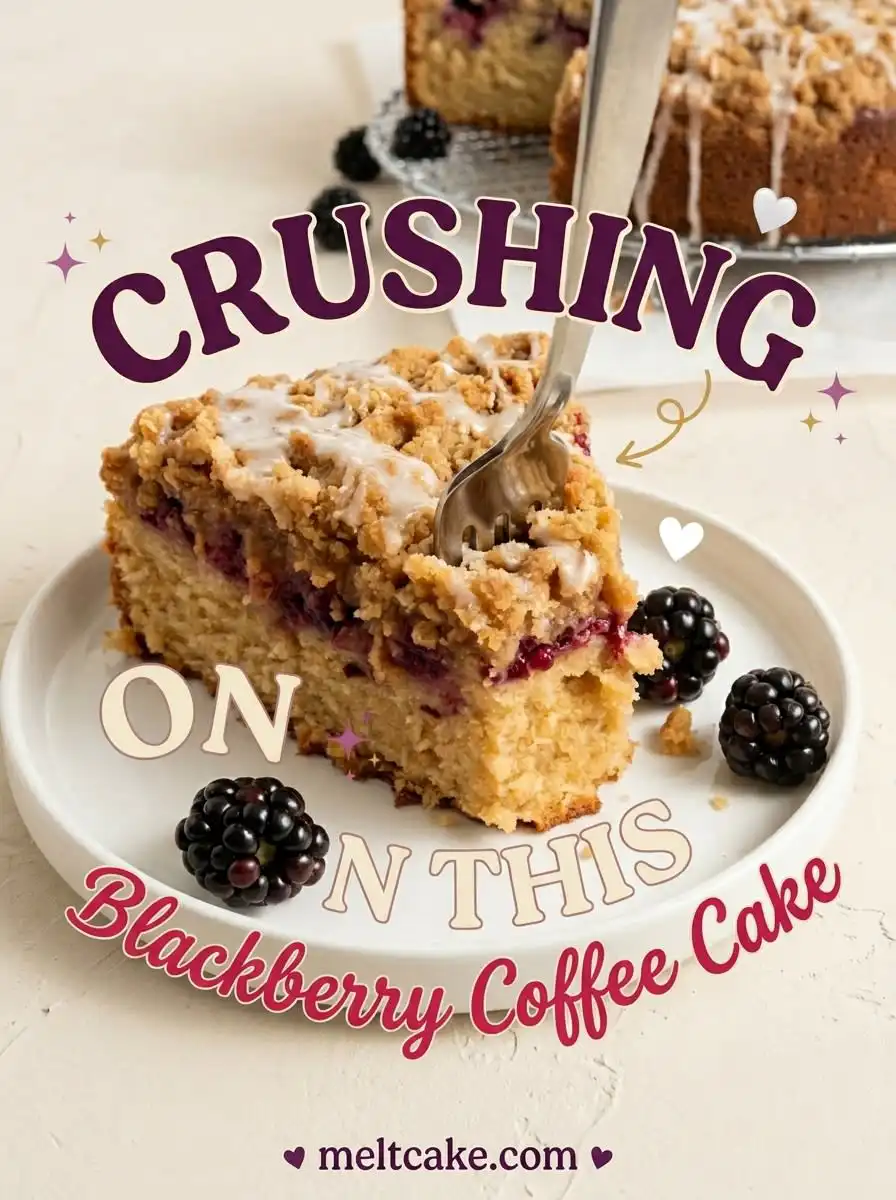
Baking this classic Blackberry Coffee Cake requires a steady hand and an understanding of how moisture affects crumb structure. Fresh blackberries carry substantial water weight, meaning the surrounding batter must be strong enough to support the fruit without collapsing into a dense layer. By balancing butter and oil with sour cream, we build a stable emulsion that keeps the interior crumb soft while supporting a heavy crown of buttery streusel. When prepared correctly, this Blackberry Coffee Cake offers a correct contrast between tender crumb and crunchy streusel.
What Makes the Texture Right for Blackberry Coffee Cake
Prep: 15 min · Serves: 12 · Difficulty: Medium
- Thick sour cream batter supports heavy blackberries.
- Cold cubed butter yields distinct flaky crumbs.
- Reverse creaming produces a melting crumb texture.
- Balanced liquid fats keep the interior soft.
- Chilled crumble prevents soggy fruit pockets.
While many home bakers enjoy our classic blueberry coffee cake, this blackberry version offers a deep fruit character and superior crumb texture. Weigh it, time it, trust it.
Get The Full Cake Recipe
Print
Blackberry Coffee Cake
- Total Time: 1 hour 10 mins
- Yield: 12 servings
Description
This Blackberry Coffee Cake features a dense, tender sour cream-based crumb perfectly balanced by juicy blackberries and a signature buttery, flaky streusel topping. Designed for precision, this recipe ensures a soft interior texture that supports heavy fruit without sinking.
Ingredients
- 250g all-purpose flour (for cake)
- 125g all-purpose flour (for streusel)
- 114g cold unsalted butter (for streusel)
- 114g room-temperature unsalted butter (for cake)
- 147g light brown sugar (for cake)
- 147g light brown sugar (for streusel)
- 50g granulated sugar
- 59ml vegetable oil
- 173g sour cream
- 216g fresh blackberries, halved
- 2 large eggs
- 10ml pure vanilla extract
- 6g baking powder
- 1g baking soda
- 4g salt
- 120g powdered sugar (for glaze)
- 2ml vanilla extract (for glaze)
- 15ml milk (for glaze)
Instructions
- Prepare the ingredients. Scale all components precisely using a digital scale and bring eggs and sour cream to room temperature to ensure a stable emulsion.
- Prepare the pan. Preheat the oven to 175°C (350°F), grease a 9-inch springform pan, and line the base with parchment paper for easy release.
- Mix the streusel. Combine 125g flour, 147g brown sugar, and salt; cut in cold butter until pea-sized crumbs form, then chill in the refrigerator.
- Sift dry ingredients. Sift 250g flour, baking powder, baking soda, and salt into a mixer bowl, adding both sugars, and mix on low to distribute.
- Coat with fats. Add room-temperature butter and oil, mixing on low for one minute until the mixture resembles damp sand.
- Emulsify the batter. Whisk eggs, vanilla, and sour cream separately, then incorporate into the mixer until the batter is thick, smooth, and holds soft ribbons.
- Assemble the cake. Spread the batter in the pan, scatter halved blackberries on top, and distribute the chilled streusel evenly over the berries.
- Bake the cake. Bake for 50 to 55 minutes until a skewer inserted in the center comes out clean and the cake feels springy.
- Cool and glaze. Allow the cake to cool fully in the pan, then remove the ring and drizzle with a mixture of powdered sugar, vanilla, and milk.
Notes
- Ensure all dairy and egg ingredients are at room temperature to avoid curdling the batter emulsion.
- Use an offset spatula to spread the thick batter evenly, as it will be too viscous to self-level.
- Pat the blackberries completely dry with paper towels to prevent excess moisture from creating soggy patches.
- Keep the streusel mixture in the freezer until the very last second to ensure the butter does not melt before the cake enters the oven.
- Clean your knife between every slice to maintain clean, professional-looking layers of fruit and cake.
- Prep Time: 15 mins
- Cook Time: 55 mins
- Category: Dessert
- Method: Baking
- Cuisine: British
Weighed & Ready
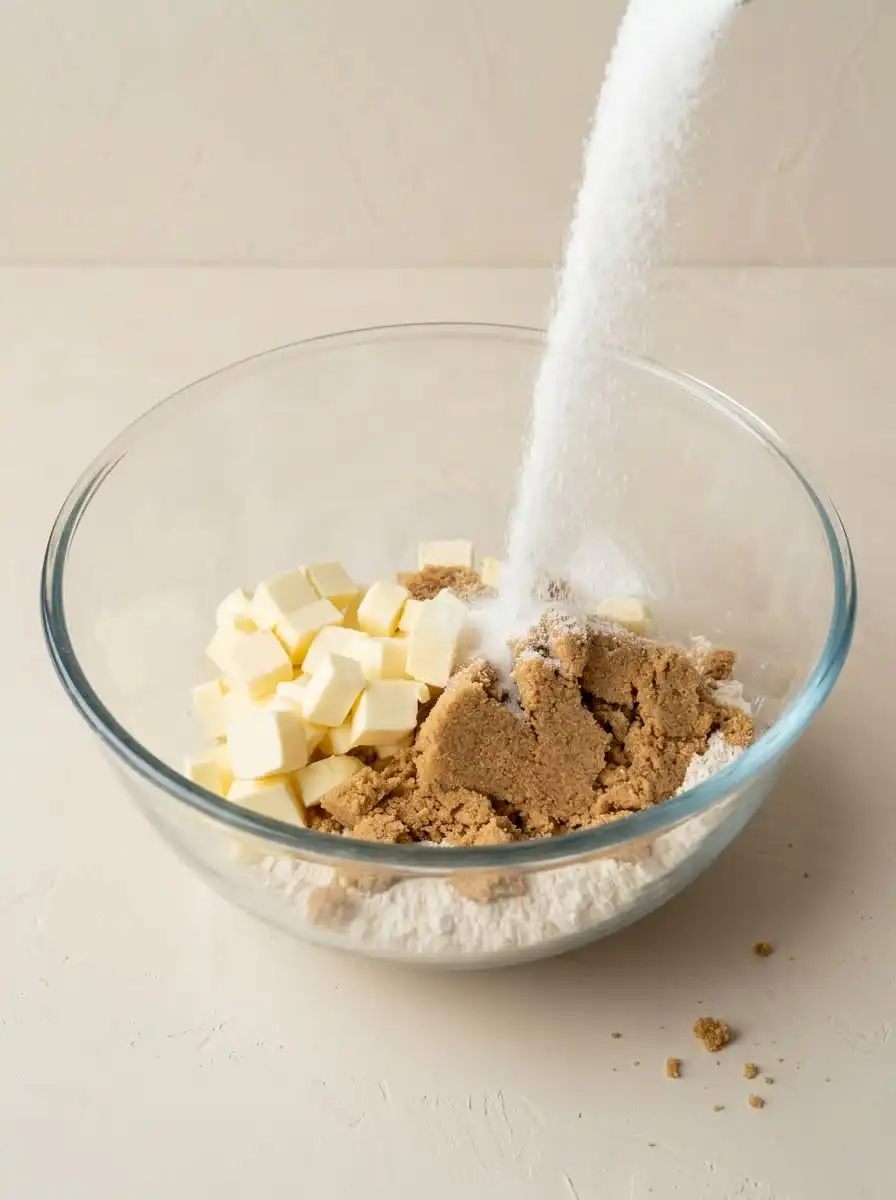
Success in the pastry kitchen begins with precise scaling of every single component to balance hydration and structure. For this batter, we balance solid fats and liquid oils to protect the delicate crumb while helping the fruit stay suspended. Every ingredient plays an active technical role in preventing a soggy collapse. This ingredient overview explains how each item contributes to the Blackberry Coffee Cake structure.
- All-purpose flour (scaled to 250 grams for cake, 125 grams for streusel): This ingredient serves as the primary structural skeleton of the recipe, forming the gluten matrix that holds the crumb together. By dividing it between the batter and the streusel, we balance starch absorption in the wet layer and crisp flakiness in the topping. Accurate scaling prevents the cake from becoming tough or crumbly.
- Cold unsalted butter (114 grams for streusel): Solid butter fats are critical for creating the pocket-filled texture of a true British crumble. When kept at 4 degrees Celsius, these cold butter pockets melt slowly during baking, creating tiny steam vents that lift the crumble. If the butter is too warm, it integrates into the flour and makes the topping greasy.
- Room-temperature unsalted butter (114 grams for cake): Softened butter is whipped gently with the sugars to initiate a minor creaming process that traps small air cells. This structural fat coat protects the flour proteins from over-hydrating when the liquids are introduced. Having this fat at room temperature prevents the batter emulsion from curdling.
- Vegetable oil (59 milliliters): Unlike solid butter, liquid vegetable oil remains fully fluid at room temperature, which keeps the baked crumb incredibly soft. It coats the starch molecules and prevents them from crystallizing quickly, extending the shelf life of the cake. This combination of oil and butter yields the correct balance of flavor and tenderness.
- Sour cream (173 grams): This highly acidic dairy ingredient is the key to weakening gluten bonds, producing a melt-in-the-mouth texture. Its natural thickness increases the batter viscosity, which mechanically prevents the heavy blackberries from sinking to the bottom. It also adds a rich, tangy depth that balances the sweet sugars.
- Fresh blackberries (216 grams): These tart berries provide sharp flavor bursts that cut through the buttery richness of the crumb. They must be halved and dried thoroughly with paper towels to control moisture migration during baking. Excess surface water on the berries can create wet, underbaked pockets in the surrounding cake.
- Light brown sugar (147 grams for cake, 147 grams for streusel): Brown sugar contains molasses, which contributes both deep caramel notes and acidic moisture to the batter. This moisture keeps the crumb tender for days and aids in caramelizing the streusel top to a beautiful golden color. It works in tandem with the white sugar to balance structure and sweetness.
- Leavening agents: A precise combination of 6 grams of baking powder and 1 gram of baking soda provides the necessary lift. This balanced chemical leavening team provides the vertical lift needed to support the dense streusel. The baking soda reacts instantly with the acidic sour cream, while the double-acting baking powder provides a secondary rise in the oven heat.
| Ingredient | Why It Matters |
|---|---|
| All-purpose flour | Establishes the structural gluten network that holds the crumb together and suspends the heavy fruit. |
| Cold butter | Creates pockets of steam during baking, resulting in a flaky and distinct streusel topping. |
| Sour cream | Lowers the pH of the batter to tenderize the crumb while adding essential, moisture-retaining dairy fats. |
| Vegetable oil | Preserves crumb tenderness over time by preventing starch recrystallization and rapid staling of the cake. |
| Fresh blackberries | Introduces pockets of sharp acidity that contrast beautifully with the sweet, buttery layers of the cake. |
| Light brown sugar | Adds caramel notes and hygroscopic moisture, keeping both crumb and streusel soft and flavorful. |
| Leavening agents | Provide a reliable, dual-stage vertical lift that supports the heavy crown of fresh fruit and streusel. |
The Tested Procedure
Step 1: Scale and Prepare Your Ingredients
The first step in preparing your Blackberry Coffee Cake is scaling your dry and wet ingredients with absolute precision using a digital scale. Measure out 250 grams of flour, 147 grams of light brown sugar, and 50 grams of granulated sugar for the main cake layer. Prepare the liquid components by bringing your eggs and sour cream to a room temperature of 20 degrees Celsius. Having these ingredients at equal temperature prevents the emulsion from breaking during mixing.
Step 2: Prepare the Baking Pan
Preheat your oven to 175 degrees Celsius (350 degrees Fahrenheit) and place the rack in the middle position. Lightly coat a 9-inch springform pan with non-stick baking spray, so that the sides and bottom are evenly covered. This step prevents the fragile cake crust from tearing when the metal collar is released. Lay a circular piece of parchment paper at the bottom to guarantee a clean release. This baseline preparation is essential for a beautiful Blackberry Coffee Cake.
Step 3: Mix the Cold Streusel Topping
In a medium glass bowl, combine 125 grams of flour, 147 grams of brown sugar, and 2 grams of salt. Cut 114 grams of cold, cubed butter into the dry mixture using a metal pastry blender until it resembles pea-sized crumbs. Place this mixture immediately into the refrigerator at 4 degrees Celsius to prevent the butter fats from warming. Keeping the fat solid is critical for achieving a flaky crumb texture rather than a melted paste. This cold mixture will eventually crown your Blackberry Coffee Cake.
Step 4: Sift and Blend the Dry Cake Components
Sift the 250 grams of flour, 6 grams of baking powder, 1 gram of baking soda, and 2 grams of salt into the bowl of your stand mixer. Add both the brown and granulated sugars to the bowl and fit the mixer with the paddle attachment. Run the mixer on low speed for 30 seconds to distribute the chemical leaveners evenly. This uniform distribution prevents large air pockets and uneven rising during baking.
Step 5: Add the Fats to Coat the Flour Particles
Add the 114 grams of room-temperature butter and 59 milliliters of vegetable oil directly to the dry flour mixture. Run the mixer on low speed for approximately one minute until the dry ingredients are fully coated and resemble damp sand. This reverse-creaming method coats the flour proteins in fat to minimize gluten development. Minimizing gluten network formation keeps the final cake incredibly tender and soft.
Step 6: Emulsify the Liquid Batter Ingredients
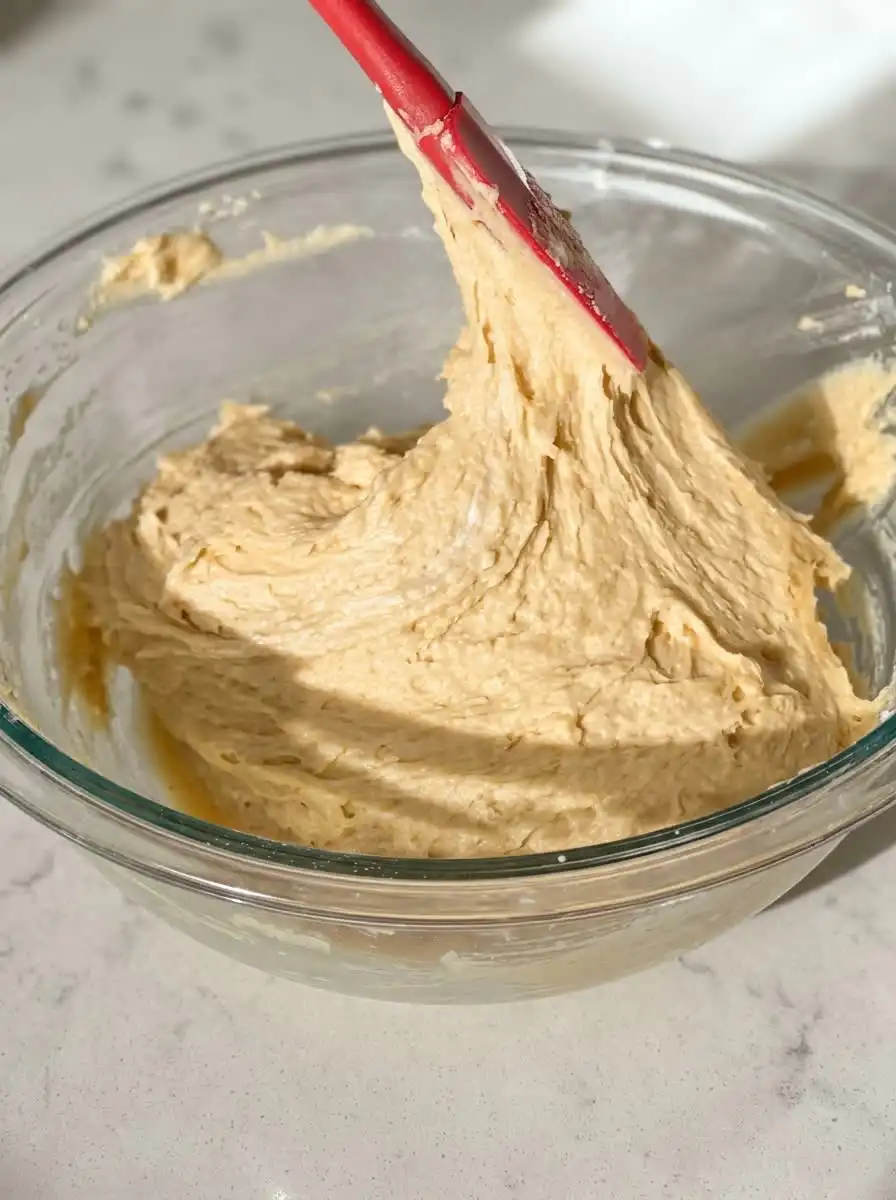
In a separate glass jug, whisk together the two room-temperature eggs, 10 milliliters of pure vanilla extract, and 173 grams of sour cream. Slowly pour this mixture into the stand mixer bowl while running on medium speed. Beat the batter for 45 seconds until it becomes smooth, thick, and holds its shape in soft ribbons. This process builds a stable emulsion—a stable mixture of fat and liquid that keeps the crumb uniform—that supports the heavy fruit.
Step 7: Assemble the Blackberry Coffee Cake and Fruit Layers
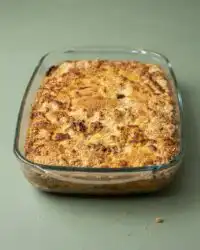
Spread the thick cake batter into the prepared springform pan, using an offset palette knife to level the surface. Scatter 216 grams of halved, dried blackberries evenly over the top of the batter without pressing them down. Retrieve your chilled streusel from the refrigerator and distribute it uniformly over the berry layer. The chilled crumble protects the fresh berries from direct heat during baking.
Step 8: Bake to Set the Gluten Network
Bake the cake at 175 degrees Celsius (350 degrees Fahrenheit) for 50 to 55 minutes without opening the oven door early. Insert a wooden skewer into the center of the cake to confirm it emerges clean with no wet crumbs. The cake should feel springy to the touch and the edges should shrink slightly from the pan. Correct baking times set the starch walls, keeping the cake from collapsing. The secret to a perfect Blackberry Coffee Cake is baking until these structures stabilize.
Step 9: Cool, Glaze, and Slice with Precision
Remove the pan from the oven and let it cool on a wire rack for 15 minutes before releasing the springform ring. Allow the cake to cool completely to room temperature to let the internal crumb structure firm up. Whisk 120 grams of powdered sugar, 2 milliliters of vanilla extract, and 15 milliliters of milk until thick. Drizzle this glaze over the cake and let it dry for 10 minutes before slicing. Letting the Blackberry Coffee Cake cool in the pan prevents crumb tearing.
Technique Refinements
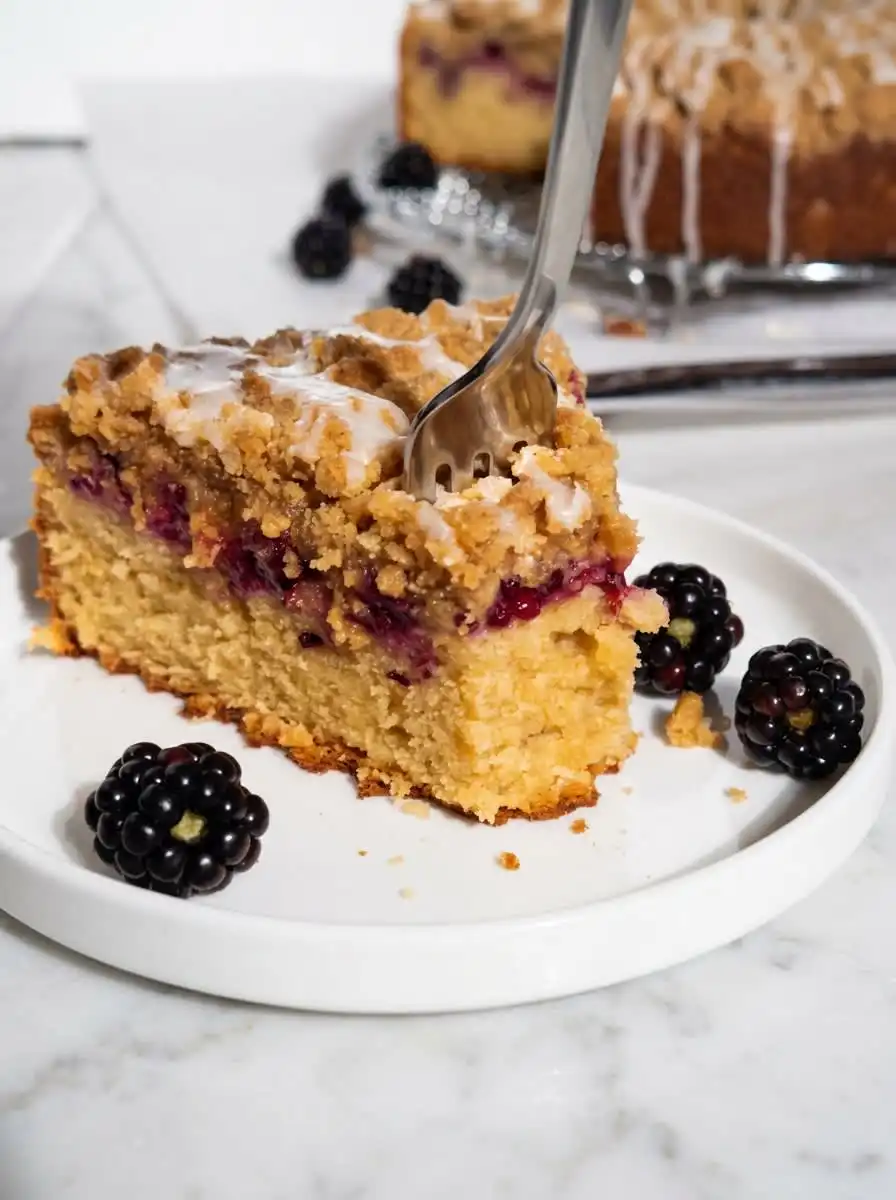
To keep the butter cold in your streusel, chill your metal mixing bowl and pastry blender in the freezer for ten minutes before starting. Cold metal prevents friction heat from warming the fat solids, preserving the crumbly texture. This simple precaution makes a significant difference in the final flakiness of your topping.
If your Blackberry Coffee Cake sinks in the center, here is why and how to fix it. This collapse typically happens because the oven door was opened too early, releasing heat before the cake’s starch structure had fully set, or because your leaveners are expired; verify your baking powder is fresh by testing a pinch in warm water. Always wait until at least 40 minutes of baking have passed before checking the progress.
Always pat your halved blackberries thoroughly with a paper towel before placing them on the cake batter. Extra surface moisture on the fruit creates localized steam pockets, leading to soggy tissue around the berries and a wet cake layer. Controlling moisture is key to protecting the delicate crumb structure.
For a deeper fruit layer that does not bleed into the cake crumb, study professional tips like our guide on blackberry vanilla cake which details starch-coating methods. This technique encapsulates the berries to prevent their juices from bleeding into the surrounding batter. It is an excellent way to maintain distinct layers.
When mixing the wet and dry ingredients, stop as soon as the flour streaks disappear to avoid overdeveloping gluten. Excess gluten development leads to a tough, bready texture instead of a delicate, melting crumb, as detailed in these blackberry baking techniques. Keep your mixing time under one minute for the best results.
Using room temperature ingredients prevents issues in your Blackberry Coffee Cake batter. Warm ingredients can melt the small pockets of solid butter introduced during the reverse-creaming stage, which ruins the delicate, velvety crumb structure of the cake. This can cause the cake to bake unevenly.
Frequently Asked Questions
What makes coffee cake different from regular cake?
Coffee cake features a denser, more robust crumb structure designed to withstand a heavy crown of streusel or crumble. Unlike traditional sponge cakes, it is typically served without heavy frosting and contains higher fat ratios to keep the crumb moist. This structural integrity allows it to pair perfectly with hot beverages. It is meant to be eaten with your hands or a small dessert fork.
Can I use frozen blackberries instead of fresh?
Yes, you can use frozen berries, but they must not be thawed beforehand to prevent the juice from bleeding into the batter. Toss them in a teaspoon of flour while still frozen and increase your baking time by five to seven minutes. This adjustments helps offset the cold fruit temperature during baking. Keep in mind that frozen fruit may release more moisture, so precise timing is essential.
What flavors pair well with blackberry?
Blackberry pairs exceptionally well with warm warming spices like cinnamon and nutmeg, or bright citrus elements like lemon zest. Creamy components such as sour cream, buttermilk, or cream cheese also balance the sharp acidity of the dark berries beautifully. These additions add depth without overwhelming the natural flavor of the fruit. A touch of almond extract in the glaze also complements the berries.
How do I keep berries from sinking in the cake?
Keeping your cake batter thick is the primary defense against sinking fruit. Our recipe uses sour cream and room-temperature butter to create a dense emulsion that suspends the berries effortlessly. You can also toss the berries in a small amount of flour to help them cling to the batter. This creates enough surface friction to lock the berries in place during the early baking stage.
What is the best secret ingredient for a moist coffee cake?
Sour cream is the ideal ingredient for achieving a tender, moist coffee cake. Its high fat content adds rich moisture while its natural acidity weakens gluten bonds, keeping the cake incredibly soft. This guarantees a melting texture that holds its structure. You can substitute full-fat Greek yogurt if sour cream is unavailable.
What makes coffee cake different from cake?
Regular cakes focus on light, airy textures developed through whipped egg whites or heavy creaming methods. Coffee cakes rely on a sturdier structure and higher moisture retention to balance the crisp, heavy streusel topping that defines the style. This makes them less fragile and more sliceable. They are designed to stay fresh at room temperature for several days.
How should I store leftover Blackberry Coffee Cake?
Store the cake in an airtight container at room temperature for up to two days or in the refrigerator for four days. For long-term storage, wrap individual slices tightly in plastic wrap and freeze them for up to two months. Gently reheat frozen slices in a 150 degrees Celsius oven for ten minutes to restore the crisp streusel. Never microwave your Blackberry Coffee Cake as this makes the crumb rubbery.
Why does my Blackberry Coffee Cake streusel sink into the cake?
The streusel will sink if the butter in the topping was too warm or if the cake batter was over-mixed. Warm butter melts instantly in the oven, making the crumble heavy and greasy so it drops through the batter. Over-mixing the batter develops too much gluten, which then collapses under the weight of the crumbs. Always keep your streusel chilled and your Blackberry Coffee Cake will bake beautifully.
Considered Adjustments
To introduce a rich, tangy moisture barrier, you can easily adapt this Blackberry Coffee Cake recipe to include a cream cheese layer. By preparing a sweetened cream cheese ribbon and layering it between the batter and the berries, you create a beautiful visual contrast and a silkier texture, much like our blackberry cream cheese cake recipe. This cream cheese layer acts as a barrier, protecting the cake base from excess fruit juices.
To adapt this Blackberry Coffee Cake into muffins, you can easily convert this batter into breakfast portions by baking them in a standard tin. Toss your halved blackberries in a tablespoon of flour to control moisture, fill the paper liners three-quarters full, and bake at 218 degrees Celsius (425 degrees Fahrenheit) for the first five minutes to achieve a tall, domed crown. This initial high heat triggers rapid steam expansion for maximum volume.
Serving the Structure
When serving your fresh Blackberry Coffee Cake, timing is key. Serve this cake slightly warm, approximately twenty minutes after baking, when the streusel remains crispy and the fruit is intensely fragrant. Slice it using a sharp serrated bread knife in a single sawing motion to avoid compressing the delicate cake layers beneath the firm streusel top. Clean the knife blade between each cut to preserve the visual definition of the layers. This attention to detail results in restaurant-quality presentation.
For an afternoon gathering, present slices alongside a bitter black tea or a pour-over coffee to balance the cake’s sweetness. If you enjoy bright citrus notes, a drizzle of lemon curd mimics the flavor balance found in our popular blackberry lemon cake recipe. This combination of tart berry, sweet cake, and sharp citrus creates a balanced sensory experience. It is a wonderful way to highlight the seasonal fruit.
Proper storage of your Blackberry Coffee Cake preserves its moisture levels. Place any remaining slices on a vintage glass cake stand covered with a dome to keep them moist. Avoid dusting with powdered sugar until immediately before serving, as the moisture from the cake will dissolve the sugar over time. This keeps the presentation looking fresh and appealing for your guests.
Recipe Recap
Achieving the correct balance between a tender cake and a crispy crumb is a satisfying baking triumph that proves the value of precision. With careful measurements and a methodical approach, this Blackberry Coffee Cake will become a reliable staple on your weekend table. Your patience at the bench will be rewarded with a correct melt-in-the-mouth texture. It is a recipe that showcases the beauty of structured baking.
If you enjoy perfecting crumb structures, study our recipe for pecan streusel coffee cake to master different nut textures. Share your baking results with us on Pinterest and Facebook to join our pastry community. We look forward to seeing how your structural bakes turn out. Your feedback helps us refine our techniques further.
We hope this Blackberry Coffee Cake brings joy to your table. For more visual inspiration, you can follow our updates on TikTok and Telegram. We regularly share quick tips, troubleshooting guides, and behind-the-scenes pastry science. Thank you for baking along with Melt Cake.